
What I Do When My Liver Is in Crisis — A Real-Time Protocol
By Gavin Poulton, Certified Aromatherapist | February 10, 2026
I was not planning on writing today. But this morning I made a diet mistake significant enough that it doubled me over — and I decided to document in real time exactly what I did about it. Not the polished version. The real one.
If you have ever pushed your body too hard with food, sodium, alcohol, or stress and felt the consequences hit fast, this is for you.
What Happened
The Poulton family was rolling with the morning routine. Carrie was managing lunches and hair. The girls were finishing chores and getting out the door. I was helping with breakfast, making sure everyone had their morning supplements and oils, and leading morning prayer.
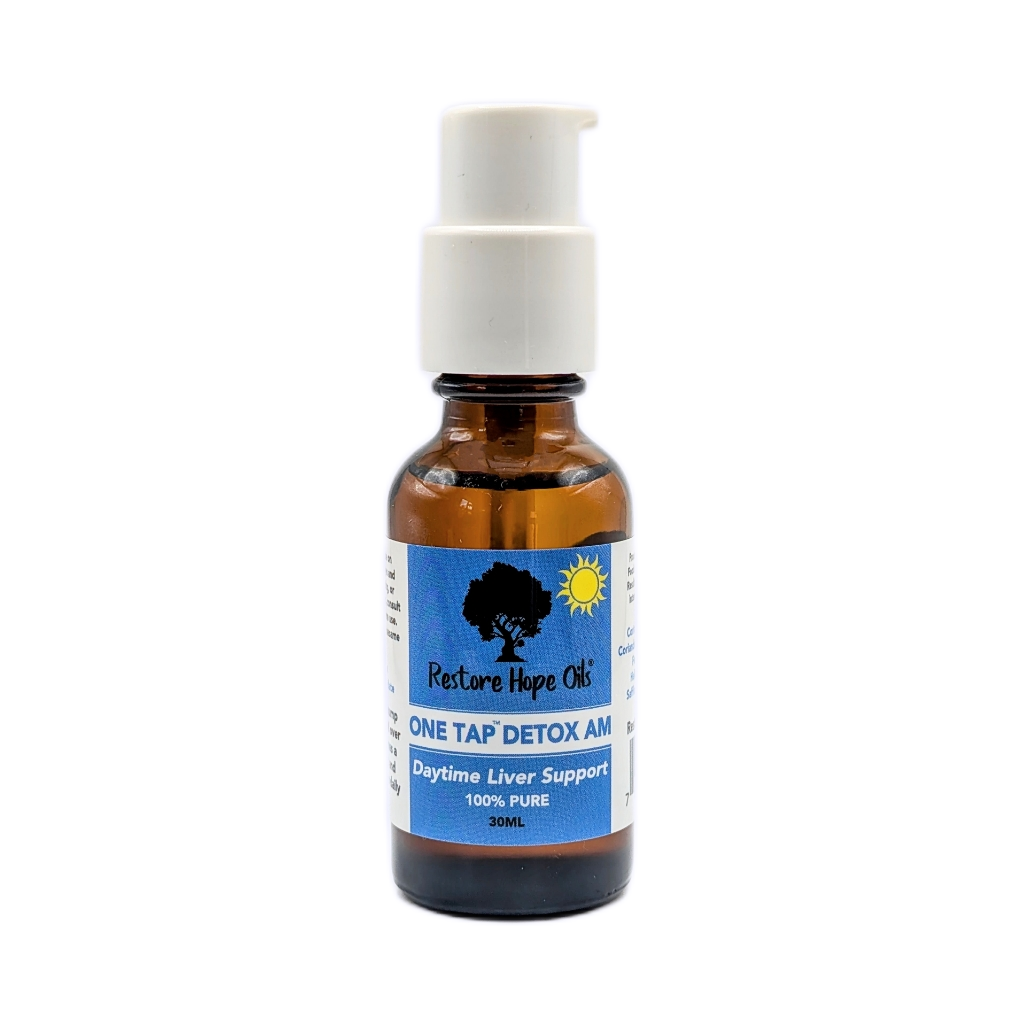
In this hurried state I applied my One Tap Detox AM over my liver and spleen, got my morning sodium and water — I tend to run low on sodium, especially in the morning — and began helping.
As things calmed down I made myself a smoothie. I usually add just a few sprinkles of sea or Himalayan salt, but this morning it was a new container and a massive amount came out into my protein powder. I don’t like to waste, so I moved forward trusting this would be a savory smoothie — and boy was it.
What I failed to calculate in the rush was that the protein powder alone contained about 20% of my daily sodium. Combined with the salt that spilled in, I was likely pushing my total daily intake in a single drink.
I got halfway through the smoothie and I could sense it coming. I dumped it as the discomfort hit hard and fast. Pain radiated from the right side to the left and back — the liver crying for help along with the spleen. 2026 now marks 17 years of experiencing a life-threatening liver condition. I knew exactly what was happening.
My body needs sodium; I have tracked mine as low over time. The sodium was not the problem. The amount all at once was.
What Was Actually Happening Inside My Body
This was not in my head. When the liver encounters a sudden sodium surge, it responds with inflammation — and research bears this out. Multiple peer-reviewed studies have now established that high sodium intake is a direct risk factor for liver disease, triggering inflammatory proteins in the liver and promoting oxidative stress that accelerates damage (Sources 1, 3, 4). One study published in Circulation found something even more unsettling: the liver retains a kind of “inflammatory memory” from high-salt exposure, meaning the damage does not simply stop when the sodium clears — the liver remembers it (Source 2).
For someone like me, whose biliary tree is already compromised by Primary Sclerosing Cholangitis, a sudden sodium overload creates an environment where bile becomes more concentrated, the biliary tree constricts under stress, and inflammation escalates quickly. The pain radiating from the right side (liver) to the left (spleen) reflects the portal vein connection between these two organs — when one is under acute stress, the other feels it.
This is why I felt it so fast. It was physiological — and it required a physiological response.
Step 1: Protect
The first thing I needed was foundational support. I grabbed my One Tap Detox AM and applied it over the liver and spleen even though I had already put it on earlier that morning. I needed hepatoprotectives air dropped in through the skin — not through something internal that would place significant additional metabolic stress on an already overwhelmed liver.
Those of you who have followed me for a while know this is the outside-in approach. When the liver is in crisis, the last thing it needs is to process another supplement or food at full metabolic cost. Through the skin, the liver still encounters the essential oil compounds, but at a fraction of the metabolic demand compared to breaking down an oral supplement. In a moment like this, that difference matters.
Why Topical Matters in a Crisis
This is where I want to slow down and explain something I feel strongly about. Most liver support products on the market are oral supplements — capsules, tinctures, powders. And for general maintenance, supplements can have real value. But in an acute moment of liver distress, anything taken orally must be metabolized by the liver before it can help the liver. You are asking an overwhelmed organ to take on significant additional work in order to receive relief.
The essential oils in One Tap Detox AM are monoterpene-dominant — Lemon, Peppermint, Rosemary, Fennel — smaller molecules with documented higher dermal penetration rates. Applied topically over the liver area, they reach liver tissue through the skin and bloodstream with far less metabolic burden than an oral route would require. In a crisis, that reduced demand on the liver is exactly the point.
At the same time I began to sip water — not gulping, because too much water too fast would add its own stress. Just enough to begin diluting the sodium level in my body.
Step 2: Release
With the foundation in place, I needed to help the liver open up. I sat down in a recliner and leaned back at an incline — not flat — and slowed my breathing. In through the nose, out through the mouth.
I had to calm my mind because the brain wants to freak out and adrenaline wants to kick in. And here is where the science gets important: more anxiety or fear does not just feel bad — it actively makes liver stress worse.
The Brain-Gut-Liver Axis
A December 2022 study published in Frontiers in Cellular and Infection Microbiology examined what they called the Brain-Gut-Liver Axis — the pathway by which chronic psychological stress promotes liver injury and fibrosis. The researchers found that psychological stress disrupts gut microbiota, increases intestinal permeability, and allows bacterial endotoxins to reach the liver through the portal vein. Once there, these endotoxins activate inflammatory signaling pathways that exacerbate liver damage (Source 5).
The critical finding: the greatest tissue changes occurred in subjects that were already experiencing liver fibrosis. In other words, if your liver is already under stress, psychological stress does not just add to the burden — it multiplies it.
This is why my breathing work was not optional. It was not meditation for the sake of meditation. It was a physiological intervention to reduce the inflammatory cascade that fear and adrenaline would trigger in my already stressed liver.
Why Geranium
As I sat in the discomfort, which was strong, I was feeling for where the greatest radiation of pain was. It was just to the right of the sternum — the bile ducts. The liver needed Geranium.
I applied 2 drops of Geranium over the liver and bile duct area and a drop over the spleen. Why Geranium specifically?
Geranium essential oil contains geraniol, an acyclic monoterpene alcohol. In my 17 years of experience, Geranium is the oil I reach for most when bile flow needs support and inflammation needs calming — and the research confirms what my body has taught me. Multiple studies have demonstrated geraniol’s hepatoprotective effects, showing it reduces key markers of liver damage while increasing protective antioxidant levels in liver tissue (Sources 6, 7). One study even found that geraniol elevated cytokines essential for liver regeneration — suggesting it supports not just protection but the liver’s ability to rebuild (Source 8). And geranyl acetate, a constituent found in Geranium oil, has been documented as choleretic — meaning it promotes the secretion of bile, supporting the very flow that was being impeded by the sodium-induced stress on my biliary tree (Source 9).
I applied the Geranium and went back to sitting.
The Emotional Release
Then came the deeper release — the emotional one. As the discomfort continued I changed my focus to one of forgiveness. I breathed slowly and began to thank my body for all of its effort to help me.
When we make a diet mistake like this, I have learned by sad experience that the worst thing a person can do is relive the mistake — continually feeling or saying in their mind how they should have known better, or they are better than that, or that was such a stupid mistake. These thoughts rushed over me and I had to imagine a STOP sign in my mind.
This is not just mindset work. Given what the Brain-Gut-Liver Axis research tells us — that psychological stress activates the same inflammatory pathways that damage liver cells — self-condemnation in a moment of liver crisis is functionally the same as adding another stressor to an organ that cannot handle one more thing. Just like taking a supplement, high amounts of water, or eating something would add metabolic stress the liver cannot handle right now, so does unkind emotion or anger towards self.
In Traditional Chinese Medicine, the liver is understood as the anger center of the body — the organ where we store unprocessed feelings. Most of us experience liver challenges in part because we have refused to let go of anger towards others and self. These moments of mistakes are often when the perfectionist side of us comes out to condemn us. We can choose not to engage and encourage release instead.
Express forgiveness and love to your body. Thank it. Encourage it.
Step 3: Repair
I sat for 45 more minutes breathing, thanking, encouraging, forgiving. The pain slowly dissipated, but I could feel the liver was so tired. As things began to calm I applied I Am Peace over my heart. The adrenaline and anxiety from the morning had put stress on more than just the liver, and my body was asking for support there too.
This is what listening looks like — not a checklist, but a conversation with your body as it tells you what it needs next.
I committed to a light physical day and decided I would fast from all foods and supplements for a few hours until dinner. No additional metabolic demands. Just water, rest, and kindness. I continued to apply Geranium later in the day and listened for what my body needed.
Repair is not passive. It is an active choice to remove demands and create space for the body to rebuild. The liver performs deep repair when it encounters fewer toxins and interruptions. My job was to give it that environment — and to stay out of its way.
Protect. Release. Repair. — In Real Time
Those of you familiar with my framework just watched it play out — not in theory, but in my kitchen and my recliner on a Tuesday morning.
Protect: Hepatoprotective essential oils applied topically through the outside-in approach, providing support with far less metabolic burden than an oral route.
Release: Opening bile flow with Geranium, calming the nervous system through breathwork, and releasing emotional stress that compounds liver inflammation.
Repair: Fasting, resting, applying I Am Peace for heart and nervous system support, and giving the liver the space it needs to recover.
You Are Not Alone
I am okay. I will be okay. And I shared this not because I wanted sympathy or to be the center of attention, but because I want you to know that you are not alone in the diet mistakes you make.
No one is perfect. You and I will mess up. The key is to calmly assess, provide foundational support, rest, forgive, and move on.
We all make mistakes in our diets and in life. As we look to our body as a partner we strive to give it what it needs. This morning the elements of my diet were not bad, but the amount of sodium threw off the balance. This is no different than when you or I have too much food in one sitting, or when someone has too much alcohol.
You are more than your current health, appearance, or current job. Your value does not change based on your mistakes. You provide value as you are. Give your body the same love.
Hope on my friends,
Gav
Products Referenced in This Post:
- One Tap Detox AM — Foundational hepatoprotective liver support (Protect stage)
- Geranium Essential Oil — Bile flow support, blood tonifier, emotional release (Release stage)
- I Am Peace — Heart and nervous system calming (Repair stage)
Want to learn more about liver support? Download our free Essential Oil Product Guide for a complete overview of how we approach wellness from the outside in.
These statements have not been evaluated by the Food and Drug Administration. These products are not intended to diagnose, treat, cure, or prevent any disease. The information provided is for educational purposes only and is not intended as medical advice.
Sources
-
Mokhtari, Z. et al. (2022). “Sodium in relation with nonalcoholic fatty liver disease: A systematic review and meta-analysis of observational studies.” Food & Nutrition Research. https://pmc.ncbi.nlm.nih.gov/articles/PMC9094449/
-
Gao, P. et al. (2022). “Salt-Induced Hepatic Inflammatory Memory Contributes to Cardiovascular Damage Through Epigenetic Modulation of SIRT3.” Circulation. https://www.ahajournals.org/doi/abs/10.1161/CIRCULATIONAHA.121.055600
-
Dietary Sodium and Nonalcoholic Fatty Liver Disease: A Systematic Review (2023). https://pmc.ncbi.nlm.nih.gov/articles/PMC10045331/
-
High salt diet causally increases metabolic dysfunction-associated steatotic liver disease risk: A bidirectional Mendelian randomization study (2025). https://www.sciencedirect.com/science/article/abs/pii/S0271531725000399
-
Xu, M.Y. et al. (2022). “Brain-gut-liver axis: Chronic psychological stress promotes liver injury and fibrosis via gut in rats.” Frontiers in Cellular and Infection Microbiology. https://www.frontiersin.org/journals/cellular-and-infection-microbiology/articles/10.3389/fcimb.2022.1040749/full
-
El-Sayed, E.M. et al. (2020). “Hepatoprotective Impact of Geraniol Against CCl4-Induced Liver Fibrosis in Rats.” Pakistan Journal of Biological Sciences. https://pubmed.ncbi.nlm.nih.gov/33274899/
-
Algefare, A.I. et al. (2024). “Geraniol prevents CCl4-induced hepatotoxicity via suppression of hepatic oxidative stress, pro-inflammation and apoptosis in rats.” Toxicology Reports. https://www.sciencedirect.com/science/article/pii/S2214750024000076
-
Simsek, A. et al. (2017). “The Effect of Geraniol on Liver Regeneration After Hepatectomy in Rats.” https://pmc.ncbi.nlm.nih.gov/articles/PMC5411747/
-
Trabace, L. et al. (1994). Choleretic properties of essential oil constituents including geranyl acetate. Referenced in ScienceDirect Topics. https://www.sciencedirect.com/topics/pharmacology-toxicology-and-pharmaceutical-science/choleretic-agent

Written by Gavin Poulton